Showing posts with label Pakistan. Show all posts

Tuesday, 25 October 2011

Pak scholars achieve top honours in Olympiads

Young Pakistani scholars brought laurels to the country by achieving top honours in International Olympiads of Biology, Physics, Chemistry and Mathematics held in different parts of the world.

All four members of the Pakistani team won bronze medals in International Biology Olympiad held in Taiwan from July 10-17, 2011. Two students won bronze medals and two honourable mentions in International Physics Olympiad hosted by Thailand from July 10-18, 2011. Two of the four Pakistani teams won bronze medals while one of them clinched honourable mention in International Chemistry Olympiad held in Turkey from July 10-18, 2011. In the International Mathematics Olympiad held from July 16-24, 2011 in the Netherlands, one student won bronze medal and one honourable mention.

In order to encourage and appreciate the winning students, an award distribution ceremony for the 7th National Science Talent Contest (NSTC) was held at the Higher Education Commission (HEC) on Tuesday. The students groomed under the NSTC participated in International Science Olympiads in Biology, Chemistry, Mathematics and Physics.

The position-holders of International Biology Olympiad included Armaghan-e-Rehman Mansoor, Numra Abdul Aleem, Urooj Imdad Ali and Saneeha Shahid. The position-holders of International Physics Olympiad included Urwa Muaz, Muhammad Umer while the honour of honorary mention has been received by Salman Azmat, Ibrahim Ahmed and Khawaja Zaigham Feroz.

The high-achievers in International Chemistry Olympiad included Syed Muhammad Saad Imran, Marium Ahmed Uqaili while Amna Rashid and Uzair Ijaz Khan received the honorary mention award. The high-achiever in Olympiad of Mathematics included Waqar Ali Syed while Hammad Ali Khan Seyal, Misha Nasir Jamy and Syed Muhammad Ahmed Ghufran received the honorary mention .

Speaking on the occasion, HEC Chairman Dr. Javaid Laghari said that it was encouraging to see that the Science, Technology, Engineering and Mathematics (STEM) Careers programme, a joint venture of the HEC and Pakistan Atomic Energy Commission, grooms and provides avenues for international competitions for these youngsters.

Tuesday, 27 September 2011

Pak Navy Fast Attack Craft launched

ISLAMABAD: The Pakistan Navy has become the first maritime force in the region that is equipped with stealth technology after its first Fast Attack Craft (FAC) equipped with missiles was launched on Tuesday. India also launched its FAC on the same day in Kochi.
"The version Pakistan has bought has far better qualities and added features including cost efficiency and multi-role in any combat activity," said an insider. "The inclusion of the FAC-M in Pakistan navy will enhance its capacity to fight against terrorism and extremism."
According to the Pakistan Navy, the FAC-M, designated as PNS Azmat was launched at Tianjin (Xingang Chinese Shipyard) in an impressive ceremony where Pakistan's Chief of Naval Staff (CNS) Admiral Noman Bashir was the chief guest. The vessel will be the first of the Azmat class FAC, scheduled to be delivered to the Pakistan Navy within six months.
The missile craft construction project represents a quantum leap, not only in defence production in the maritime sector of Pakistan, but also addresses a long-standing operational requirement of the Navy. The fast attack craft is equipped with advanced weaponry and sensors, including the C802A surface-to-surface missile, and has stealth features. The FAC in question has a crew of 12 to 14 sailors, less than half that of similar craft. At a unit cost of an estimated $50 million each, a Navy with limited resources could afford both the financial and manpower commitment.
Admiral Noman Bashir, who has brought several innovations in Pakistan, addressed the ceremony marking the launching of FAC-M.
Acknowledging the efforts of Chinese engineers and technicians for the construction
of FAC-M, the chief guest felicitated the China State Shipbuilding Company (CSOC), Xingang Shipyard for their full cooperation and commitment in launching the craft as per schedule and remarked that this was yet another example of the unique and unparallel relations between the two countries.
"The Pakistan-China relationship is unique and does not draw any parallel in the world.
This relationship over the years has matured in all fields, particularly in defence," he said, adding that the current geo-political situation demands further strengthening of ties between the two countries.
The CNS said that this project represents a quantum leap not only in the defence production in Maritime Sector of Pakistan but also addresses a longstanding operational requirement of Pakistan Navy.
"The collaboration in this project hopefully will open new vistas of cooperation which will be yet another milestone in defence cooperation between China and Pakistan," he said, adding that the induction of the missile craft will not only supplement Pakistan's combat potential but also afford the Pakistan Navy the opportunity to distinctly uphold its forward presence in the area of interest, contributing to a balance the power in the region.
The admiral said the environment around us warrants the Pakistan navy to be prepared to counter the forces challenging our sovereignty as well as regional peace and security.
Admiral Noman Bashir said he was confident that the construction of the second fast attack craft in Pakistan will be accomplished successfully with the full cooperation ofChina.
The Indian media has reported that India added a new warship to its fleet with the commissioning of FAC in Kochi to aid in anti-piracy operations in the Arabian Sea. It has been named after an island in the Andaman and Nicobar archipelago as Kabra.
Vice Admiral Sushil underscored the importance of relatively smaller ships like fast attack craft for a blue water navy, saying the assets were an essential inventory in peacetime for low intensity conflicts and anti-piracy operations.
It is the eighth of a series built with borrowed technology. The main armament of the ship is a 30mm CRN 91 gun. In addition, the ship has been fitted with machineguns of various types and shoulder launched surface-to-air missiles. INS Kabra has a three-officer and 39-sailor crew.

Mushahid honoured with Cambodian Award

ISLAMABAD, Sep 25 (APP): Pakistan Muslim League (PML) Secretary General Mushahid Hussain was decorated with one of the highest awards of Cambodia at an investiture ceremony held at Phnom Penh, capital of Cambodia. The Award, Grand Order of the Kingdom of Cambodia, was awarded for  Mushahid Hussain’s services for promoting Asian causes and bringing Asian  people closer together’. The award was presented by Cambodian Prime Minister Hun Sen, while the former Speaker of the Philippines and former Vice President of Indonesia also received similar awards.

Mushahid Hussain is the first Pakistani to be so honoured by an Asian country like Cambodia, said a press release.
Before getting the Award, Mushahid Hussain also was keynote speaker at an International Forum on “Asian Century: Challenges and Prospects”, which was attended by an audience of 500 invited guests.
In his speech, Mushahid Hussain spoke about the sacrifices and contributions of Pakistan since 1979, when it helped the West win the Cold War by helping to defeat the Soviet Red Army in Afghanistan and hosted the world’s biggest ever refugee population of nearly 3 million Afghan refugees for over 3 decades.
Mushahid Hussain said 3 events in 1979 had influenced the course of modern Asian history: the Soviet military intervention in Afghanistan, the Iranian Revolution and China’s historic decision to reform and open up its economy, which resulted in lifting 500 million people out of poverty within a generation, now making China the world’s second largest economy.
He also referred to the resilience and sacrifices of the Pakistani people since 9/11, when over 40,000 Pakistanis were victims of terrorism, including 10,000 from the security forces.
Regarding the financial costs of the war on terror, Mushahid Hussain said while the United States was spending $ 2.5 billion every week on the war in Afghanistan, it had promised Pakistan $ 12.5 billion aid over a 5 year period,which came to the same amount of money that the US was spending in just 5 weeks of the Afghanistan War.
He also compared the US strategy in Afghanistan with the American war in Vietnam and Cambodia in the 1970s.
Mushahid Hussain also presented a profile of 21st century Pakistan, terming it as a ‘dynamic democracy with a free media, an independent judiciary and a vibrant civil society’.
The International ‘Asian Century’ Forum was also addressed by former Prime Minister of Thailand, Thaksin Shinawatra, and presided over by Cambodian deputy Prime Minister Sok An. Diplomats, ministers, professors and students were among those attending the forum.

“WTN” award nomination for Pakistani Scholar


Pakistani scholar Dr. Athar Osama has been nominated for the “World Technology Network” award. The awards to be distributed in the World Technology Summit, to be held at the United Nations Headquarters in New York City, USA on October 25 – 26, 2011. – Image courtesy by Athar Osama

rameen Bank), Mark Zuckurberg (Facebook founder), Larry Page (Google) and Tim Berners – Lee (Inventor of Internet), however, no Pakistani has won this award as yet.
The awards to be distributed in the World Technology Summit, to be  held at the United Nations Headquarters in New York City, USA on October 25 – 26, 2011.
WTN selects the finalists through a peer reviewed process and a well established criteria. On individual bases, the awards are distributed in 20 categories such as arts, biotechnology, education, energy, entertainment, health, media and journalism and information technology. WTN also awards to the companies and organisations in10 different categories. The WTN awards have been presented since 2000. Prominent advisors and professionals are included in the selection panel of WTN awards.
“This year we are more eager than ever to pay tribute to the talent and innovation of our individual and corporate honorees,” said James P. Clark, Founder and Chairman of the World Technology Network.
Dr. Athar Osama frequently writes about science, technology and innovation issues especially on Islamic countries. He is the director of Middle East and Asia for ANGLE Plc – a UK based firm for technology commercialisation and policy. He also works at RAND Corporation in Santa Monica, CA as a science and technology policy analyst.
Recently, he launched Muslim-Science.Com, an online journal discussing the issues of Science, Technology, Innovation and Policy mainly concerned with Muslim countries.
Osama did his Bachelors from the Pakistan Air force Academy and did his doctorate in public policy from Pardee RAND Graduate School.

Just read and feel PROUD TO BE PAKISTANI

1. Pakistan is the most connected country in South Asia, with the highest teledensity
2. Pakistan's communications costs are lower than any other country in the region
3. Pakistan has the world's largest biometric database (NADRA); this system (not the data) is now being provided to allied countries
4. Pakistan has the world's largest WiMAX network
5. Pakistan has one of the world's most aggressive Fibre-to-the- Home (FTTH) rollouts
6. Pakistan has one of the highest rates of cellular connectivity growth in the world (According to PTA 2007's report the rate of growth in Pakistan's mobile sector is fourth highest in the world)
7. Pakistan was the winner of the 2007 GSM industry association award
8. The US is importing UAVs designed and built in Pakistan to protect America's borders
9. With WLL (CDMA), WiMAX, GSM and FTTH, Pakistan is pretty much leading the pack in terms of diversity and breadth of connectivity
10. According to Gartner, Pakistan is a "first category" offshoring location; this ranking has grown by leaps and bounds
11. Pakistani companies won several awards at Asia's APICTA startup/innovation conference and were considered the most "interesting" and cutting edge in Asia 12. The world's youngest Microsoft Certified Professional is a Pakistani and so if the world's youngest Cisco CCNA professional
13. Pakistani students excelled in MIT's global software talent competition
14. Citations of Pakistani scientific publications are rising sharply
15. Over two dozen Pakistani scientists are working on the Large Hadron Collider; the grandest experiment in the history of Physics

Tuesday, 9 August 2011

Paksat-1R launch in China this week

BEIJING (INP) - Paksat-1R, a Pakistani geostationary and an advanced communication satellite, is due to be launched in space from a Chinese satellite launching site in Xichang city in the second week of August, depending on weather conditions.
Paksat-1R will replace Paksat-1, which is going to complete its useful life this year.
“Paksat-1R is going to be a new symbolic development in Pakistan-China relations, as it will broaden the horizons of cooperation between the two countries,” said Pakistan’s Ambassador to China Masood Khan.
In an interview to mark the launch of Paksat-1R, the ambassador said that during Chinese Premier Wen Jiabao’s visit to Pakistan in December last year, the two governments had decided to deepen cooperation in space science and technology.
“The satellite, Paksat-1R, is a big step in that direction,” he said, adding, “It will revolutionise the use of broadband Internet, digital television broadcasting and mobile telephony. “It will spur our economy, strengthen the education and health sectors and help us with disaster preparedness and response.”
Khan held that such cooperation with China would help Pakistan move towards self-reliance.
Tracing the history of cooperation between the two countries in the realm of space science, the ambassador said that “it goes back to the 1990s, when Pakistan launched its first low earth orbit satellite Badr-1”. Since then, we had been enhancing “our cooperation” in space science and technology, he added.
“We are now looking at cooperation in remote sensing satellites. It is a long term project with many civilian uses. A remote sensing satellite will cover areas like agriculture, oceanography, disaster management and mitigation, crop monitoring, earth observation, water resources management, weather forecasting and urban planning. Such an application will have a direct positive impact on Pakistan’s socio-economic development.”
Expressing gratitude on behalf of the Pakistani nation to China for its support to Pakistan for developing its satellite industry, Khan said the Pakistan Space and Upper Atmosphere Research Commission (SUPARCO) had been establishing the necessary space technology infrastructure. “We are developing common technology platforms with China.” In the due course of time, he added, Pakistan would want to develop its spaceflight programme.
The ambassador also said that leaders and professionals of the China Great Wall Industry Corporation (CGWIC), China Academy of Space Technology (CAST) and China Aerospace Science and Technology Corporation (CASC) were keen to extend full cooperation to Pakistan. “They all are so positive, forthcoming and hospitable towards Pakistan. In this atmosphere, I am sure our cooperation will move from strength to strength,” Khan said.
He also said that “it is our natural aspiration that a Pakistani astronaut aboard a Chinese spacecraft flies to the space”. “This is possible because Pakistan and China enjoy relations of trust and confidence,” the ambassador added.

PAF completes production of 26 JF-17 Thunder jets: Pak official

ISLAMABAD: The Pakistan Air Force has completed the production of 26 JF-17 Thunder combat jets in collaboration with China during a period of two years, an official said on Tuesday.

The senior PAF official, who was briefing the public accounts committee of parliament, said while replying to a query that the air force had achieved the target set for producing the JF-17 jets in the country.

The parliamentary panel was informed that Pakistan began the serial production of the jet in collaboration with China two years ago.

The JF-17 was jointly developed by Pakistan and China. The PAF plans to induct 250 JF-17s in the coming years. Defence production secretary Shahid Iqbal told the parliamentary committee that two P-3C Orion anti-submarine and maritime surveillance aircraft were destroyed in a recent terrorist attack on a naval airbase in Karachi and efforts were being made to replace them.

Wednesday, 20 July 2011

Pakistani scientists succeed in mapping genome

Pakistani scientists have mapped genome of the first Pakistani, while with this historical achievement, Pakistan joins the ranks of the few countries - the US, UK, China, Japan and India - which have successfully sequenced the human genome.

Dr Panjwani Centre for Molecular Medicine & Drug Research (PCMD), University of Karachi (KU) and Beijing Genomics Institute, China, have jointly mapped genome of the first Pakistani, living in Karachi.

Pakistan has become the first country in the Muslim World as well that has mapped genome of a first Muslim man.

This historical announcement was made by Prof Dr M. Iqbal Choudhary, Director International Centre for Chemical and Biological Sciences (ICCBS), KU, while talking to a group of scientists at ICCBS. He said that the first Pakistani genome had been mapped using a newly developed technology ten years after the first human genome was discovered. The PCMD, working under the umbrella ICCBS, had reported mapping of the entire genome of a Pakistani male in just 10 months.

The individual who has been genetically mapped is a resident of Karachi, he added.

“According to the researchers, the newly-sequenced Pakistani genome has uncovered a multitude of ‘Pakistan’-specific sites which can now be used in design of large-scale studies that are better suited for the Pakistani population. The research team was comprised of Dr Kamran Azim, Assistant Professor in the Dr Panjwani Centre for Molecular Medicine and Drug Research and Dr Yong Zhang, head of the genomics department at the Beijing Genomics Institute, Shenzhen, China; among world leading genomics institutions,” he said.

Acknowledging the fact that the complete Pakistani genome has been sequenced for the first time Dr Azim said, “The new thing in the study is the technique which can trace back a mutation to the specific parent. We are still studying the actual genome data itself and how the genetic differences we identified may predispose this particular individual to certain diseases”.

Thursday, 30 June 2011

Pakistan in Guinness Book of World Records

Guinness Book 2009
Guinness Book 2009
Jashn-e-Azadi calls for celebrating and appreciating the people who made us proud. Its the time to count our achievements as a nation and don’t forget to count the blessings of being a Pakistani!
Here is the list of all Pakistanis who made their way into the Guinness Book of World Records.
Largest Volunteer Ambulance Organization
Abdul Sattar Edhi (Pakistan) began his ambulance service in 1948, ferrying injured people to hospital. Today, his radio-linked network includes 500 ambulances all over Pakistan, and attracts funds of US$5 million a year.

Smallest Qur’an
The smallest published Koran book measures 1.7 cm x 1.28 cm x 0.72 cm (0.66 in x 0.50 in x 0.28 in). It is published in an unabridged, bound version, in fine print Arabic and is 571 pages long. Dr Muhammad Karim Beebani at October 15, 2004 in Pakistan.

Highest Margin Of Victory – One Day Int.(Cricket)
The largest victory margin is 233 runs by Pakistan against Bangladesh (320 for the loss of three wickets to 87 all out), at Dhaka, Bangladesh, on June 2, 2000.
Youngest Cricket Test Player
The youngest Test player ever is (Pakistan) who made his debut, aged 14 years 227 days, against Zimbabwe at Faisalabad, Pakistan on 24 October 1996.
Born 11 March 1982 in Karachi, like other Pakistani cricketers Raza was given test match experience very early. The right-handed batsmen has played for Pakistan Customs, Habib Bank Limited, Karachi Cricket Association, and Pakistan.
Widest Gauge Railway
The widest gauge in standard use is 1.676 m (5 ft 6 in). This wide gauge is used in Spain, Portugal, India, Pakistan, Bangladesh, Sri Lanka, Argentina, and Chile. The narrower standard gauge, 1.435 m (4.698 ft), is more common in much of America and Europe.
Most Wickets In A One-day International Career
The most wickets taken over a one-day international cricket career is 440 by Pakistan’s in 319 matches between 1985 and 2001. Wasim took the wickets at an average of 24.04 runs. Born in 1966 Lahore, started playing cricket, like many Pakistanis, on the streets. He made his international debut at the age of 18 after an invitation to join the national team’s training camp as they prepared for a match against New Zealand. Wasim’s ability to move the ball in the air combined with his pace and accuracy has earned him a reputation as one of the world’s best fast bowlers. In February 2000, he received a Lifetime Achievement Award from the Pakistan Cricket Board.
Fastest Cricket Bowler
The highest electronically measured speed for a ball bowled by any bowler is 100.23mph (161.3km/h) by Shoaib Akhtar (Pakistan) against England on 22 February 2003 in a World Cup match at Newlands, Cape Town, South Africa.
Nicknamed the ‘Rawalpindi Express’ Shoaib burst onto the cricket scene in 1999, but has since struggled to cement a first choice place in the Pakistan line-up. He has played for many teams, including: Agriculture Development Bank of Pakistan, Pakistan International Airlines, Rawalpindi Cricket Association, Somerset, Khan Research Labs, Durham, Lashings and Pakistan.
Largest Mosque
The largest mosque is Shah Faisal Mosque, near Islamabad, Pakistan. The total area of the complex is 18.97 ha (46.87 acres), with the covered area of the prayer hall being 0.48 ha (1.19 acres). It can accommodate 100,000 worshippers.
Largest Football (Soccer)
A football made from artificial leather PV-PVC and hand-sewn by staff at Ihsan Sports of Hajipura, Sialkot, Pakistan, had a diameter of 4m (13ft 1in) when measured on 30 June 2002.
The super-sized soccer ball – an exact replica of the company’s standard football – was made from 32 separate panels that were laminated, printed then hand-stitched together. It was unveiled at the Al Faysaliah shopping mall in Riyadh, Saudi Arabia, by members of the Disabled Children’s Society. “I was amazed at the size of the football,” said one spectator, “and I imagine it would be really hard to actually play with.”
Heaviest Weight Lifted With Ear
The heaviest weight lifted using only the ear is 51.7 kg (113 lb 15 oz) by Zafar Gill (Pakistan), who lifted gym weights hanging from a clamp attached to his right ear and held the weight for seven seconds on May 26, 2004 at Lahore, Pakistan.
Largest Appendix Removed
An appendix removed from a 55-year-old Pakistani man on June 11, 2003, at Pakistan Institute of Medical Sciences, Islamabad, Pakistan, measured 23.5 cm (9.2 in) in length. The operation was carried out by Dr. Riaz Ahmed Khokhar. The appendix is a long, thin, worm-like pouch sticking out of the join between the large and small intestines. Doctors are still not sure of its purpose – or even if it has a purpose – and although it contains immune-system cells, if it’s surgically removed, health doesn’t suffer.
Largest Flaming Image Using Candles
The largest flaming candle image took place at the Serena Hotel in Faisalabad, Pakistan when 48 people lit 8,154 candles to create the Sandoz logo on December 31, 2003.
Most Men’s Squash World Team Titles
The most men’s squash world champi
onship team titles won is six, by Australia, in 1967, 1969, 1971, 1973, 1989, and 1991; and Pakistan, in 1977, 1981, 1983, 1985, 1987, and 1993.

Jahangir is listed in Guinness Book of World Records as having the most world championship squash titles. He was unbeaten in competitive play for five years. During that time he won 555 matches consecutively. This was not only the longest winning streak in squash history, but also one of longest unbeaten runs by any athlete in top-level professional sport.
Pakistani student blazes his way into Guinness Book of World Record
Sitting seven A-levels might easily have done the trick, even though he had started to study some of the subjects only three days before the exam.
But he was determined to get some good grades. So he sat another three, and three more. Then another nine. Just in case, he took a couple of AS levels along the way.
The 18 year-old boy genius took the long list of exams within 12-months netting himself 22 A grades, one B and one C .Well done!
Most World Championship Squash Titles
Since the World Open was inaugurated in 1975, has clinched the title eight times, with his relative Jahangir coming close behind winning six titles. But Jahangir has also claimed three International Squash Rackets Federation world individual titles, taking his tally of World titles to a record-breaking total of nine. In 1982 Jahangir astonished everyone by winning the International Squash Players Association Championship without losing a single point! Jansher played in his first World Open in 1987 in Birmingham, England, beating Jahangir in the semi-final. Jansher has only once failed to make it to the final in the 10 World Opens he has played.
WANT TO KNOW MORE?
The famous Khan family have dominated the sport of squash for over 50 years. The champion family originates from a village called Nawakille in Pakistan. Jansher (born in 1960 and whose name means “Lion-Hearted”) succeeded his relatives – Peshawar, Hashim, Azam, Roshan, Moibullah (Senior), and Jahangir, all of them champion squash stars. Since 1950, the family has won 29 British Opens.
GUESS WHAT?Jansher Khan has beaten Australian Chris Dittmar a staggering 17 times in the finals! For much of Chris’ career he was ranked No.2 in the world, but finally managed to push Jansher off the top spot in the last week of his career

Mind-boggling “Cricket World Records” by Pakistan

Pakistan Cricket has suffered major “lows” in last 5 years due to their notorious acts. Pakistan is like a vagabond who irritates the street with his loud and notorious acts but, once he is gone, a part of you always miss him!
Pakistan has truly been a soul of this game. In every aspect of Cricket there are Pakistanis who keep the blood running in heart of Cricket. There are some astonishing and mind-boggling world records held by Pakistan. Some of those overwhelming records are:
1. Highest win/loss ratio in Home Tests
Pakistan’s home venues have become no-go zone for international teams due to security reasons but surprisingly Pakistan has the best home record in Test Cricket. Pakistan’s Win/Loss Ratio of 2.54 is the best among all nations. Pakistan has played 151 Tests at home; 56 won, 22 lost and 73 drawn, that gives ratio of 2.54 to Pakistan. Australia with 2.26 is second whereas Sri Lanka with 1.86 is third.
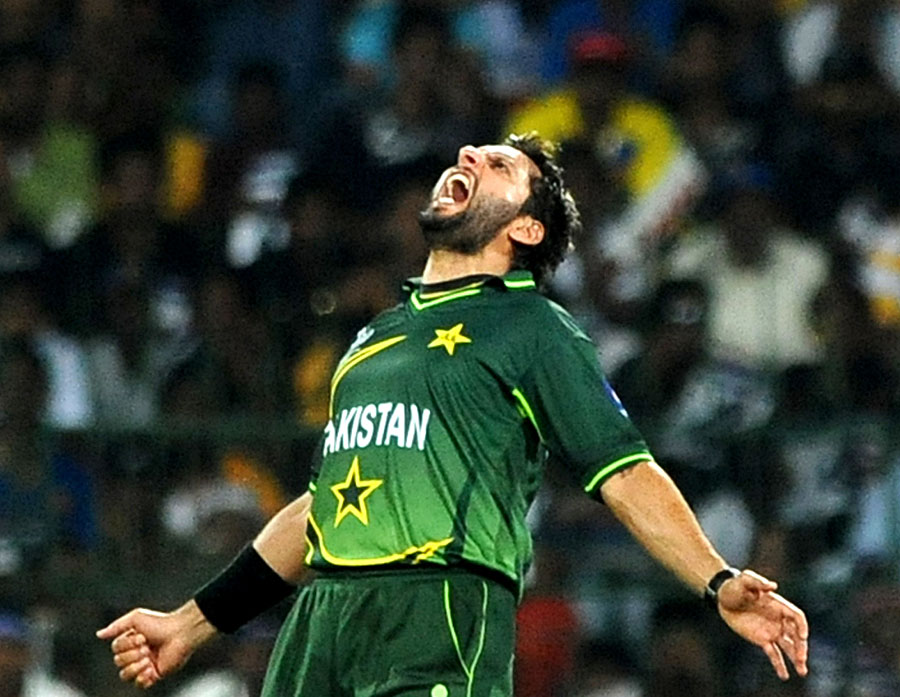
Shoaib Akhtar, who holds the record for fastest delivery ever bowled in Cricket, is ecstatic after taking wicket against South Africa
2. Fastest delivery bowled in International Cricket
In ICC World Cup 2003 match between Pakistan and England at Newlands (Cape Town), Shoaib Akhtar became the first bowler to cross the barrier of 100 mphs, his delivery to Nick Knight clocked 100.4 mph/ 161.9 kmph, making it fastest delivery bowled in International Cricket. Previously Shoaib Akhtar was claimed to bowl 100 mph by Cybernet’s speed gun in a match against New Zealand in Pakistan but ICC didn’t approve it.
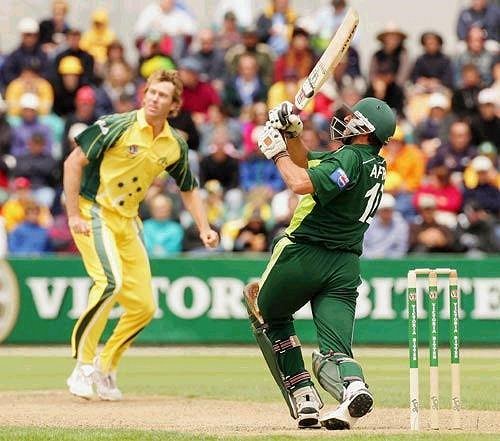
Go Pigeon get it, Its a SIX! The power of an Afridi
3. Most “Sixes” in ODIs and International Cricket
“367” is the number of Sixes Shahid Afridi has hit in international cricket (including Tests, ODIs and T20 Int.), the most number of sixes by any batsman in International Cricket. In ODIs alone, he has hit 289 Sixes which is another world record.
He was stunning with numbers and was in his prime form in 2006; a year yielded 1788 runs and 9 centuries
4. Most runs by batsman in a calendar year of Test Cricket
In 2006, Mohammad Yousuf scored 1788 runs in 11 Tests at average of 99.33. He broke the previous record of 1710 runs in 11 Tests by Viv Richards. Yousuf’s innings were against India, Sri Lanka, England and West Indies. He was in sublime form throughout the year even on hostile batting wickets of England, he scored in bulk; 631 runs in 4 Tests including a double-century and 2 centuries. During course of 1788, Yousuf also scored 665 runs in a 3 Test series against West Indies –most runs by Pakistan batsman in 3 Test series – and he hit 5 centuries in consecutive matches.
5. Nine centuries in a calendar year of Test Cricket
2006 didn’t end for Yousuf by giving him most runs in a year but it also ended up giving him 9 centuries; another world record. At end of the year, in series against West Indies, Yousuf hit 4 centuries in 3 Matches which made his tally to 9 centuries in a year. Arvinda de Silva, Ricky Ponting, Viv Richards and Sachin Tendulkar have hit 7 centuries in a calendar year.
The Boom Boom goes areal! No one, in 15 years, has matched his world record
6. Fastest century in ODI Cricket
15 years to date, the auspicious record is still possessed by Shahid Afridi, or should I say Boom Boom Afridi. On 4th October (1996), Shahid Afridi – playing his first ODI innings – annihilated the Sri Lankan bowling attack by scoring century of 37 balls with help of 11 Sixes and 7 Fours. In 15 years, no one has threatened to break this record. The record for 4th fastest (45 balls against India in Kanpur 2006) and 7th fastest (53 balls against Bangladesh in Dambulla 2010) centuries is also held by Shahid Afridi, 3 out of top 10 fastest centuries belong to Shahid Afridi.
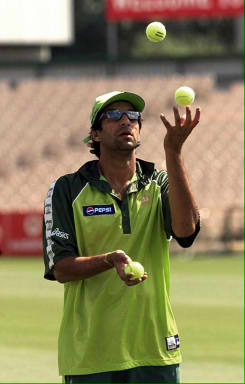
Wasim Akram was Captain's dream, fans' delight; the finest left-arm bowler Cricket has ever seen
7. Four International Hat-tricks
Wasim Akram leads the way with FOUR international hat-tricks; two in ODIs and two in Tests, most hat-tricks by any bowler in world. Akram’s two Test hat-tricks came in consecutive Tests against Sri Lanka which is also kind of a record however a bowler named James Mathews has taken two hat-tricks in one Test match. Wasim Akram was also the first Pakistani to take hat-trick in Test Cricket.
8. A Hat-trick in Test Cricket as well as ODI Cricket
Wasim Akram and Mohammad Sami are only two cricketers who have taken hat-trick in ODIs as well as in Tests. Mohammad Sami, surprisingly, has hat-trick against Sri Lanka in Tests and against West Indies in ODIs. There isn’t any bowler in World who has taken a hat-trick in all three formats of the game however Brett Lee, the Australian fast bowler, has taken a hat-trick in ODIs and Twenty20 Int.
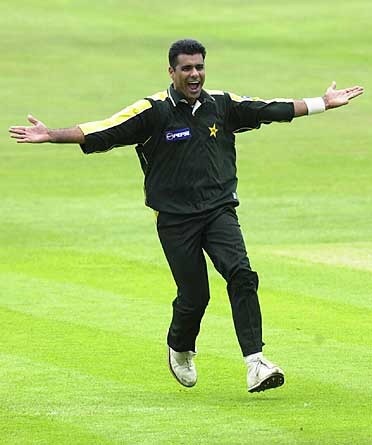
Waqar Younis on his day - with banana-swing - was a bomb waiting to blast!
8. Most five-wicket hauls in ODI Cricket
Waqar Younis has taken 13 five-wicket hauls in 262 ODIs; a record of most-wicket hauls by any bowler in ODIs, not only this, he also has record for taking most 4+ wickets in ODIs; 27 times he has taken 4+ wickets in ODI Cricket.
9. Fastest to reach 100, 150, 200 and 250 ODI wickets
All the tallies belong to one man. Perhaps the best spinner ODI Cricket has ever seen. Saqlain Mushtaq, the off-spinner of Pakistan, has record for being the fastest to reach 100, 150, 200 and 250 ODI wickets. He also has two hat-tricks in ODIs; joint record with Wasim Akram, Chaminda Vass and Lasith Malinga.
10. Most wickets in a calendar year of ODIs
In 1996, Saqlain Mushtaq took 65 wickets in 33 ODIs which was record at that time. A year later, in 1997, he bettered his record with 69 wickets in 36 ODIs. To date, Saqlain’s tally of 69 wickets in a year remains the world record for most wickets in a calendar year of ODI Cricket.
The master and the pupil in tandem; Wasim taught Shoaib how to draw first blood!
11. Most ODI Wickets on a single ground
Wasim Akram has taken 122 wickets in 77 Matches at Sharjah, that’s record for most wickets by a bowler on a single venue. Second comes another Pakistani with Waqar Younis taking 114 wickets in 61 matches also at Sharjah. None other than “ The Ws” has taken 100 or more wickets on a single venue in ODI Cricket.
My eyes become wet when I see this picture. Trust me! He is world-beater of the game
12. Most “Sixes” by batsman in an innings of a Test
Wasim Akram, in course to his famous 257* against Zimbabwe in Sheikhupura 1996, hit 12 Sixes. Surprisingly its a World Record effort. He broke the record of Wally Hammod’s 10 sixes of an innings in 1933. Later Nathan Astle  (in 2002) and Mathew Hayden (in 2003) hit 11 sixes of their innings against England and Zimbabwe respectively.
13. 400 Test Wickets and a Double-century
Wasim Akram, to date, is only Cricketer to have taken 400 wickets and to score a double-century in his Test career. He grabbed 414 Tests wickets and scored double-century, 257*, against Zimbabwe. Akram is also one of few cricketers –Abdul Razzak and James Franklyn are others which I can recall – to have scored a century and taken a hat-trick in Tests. Akram’s two Test hat-tricks and a double-century also give him an unique all-rounder record.
14. Seven players of batting line-up’s top-order scoring 50+ in a Test innings
In Pakistan’s famous Test victory against India in Karachi 2006, seven Pakistan batsman scored 50+ runs in second innings. In first innings Pakistan were bowled out on 245 but in second innings Pakistan scored 599-7 (declared) with all 7 batsmen who were out scoring 50+ runs. Salmam Butt (53), Imran Farhat (57), Younis Khan (77), Mohammad Yousuf (97), Faisal Iqbal (139), Shahid Afridi (60) and Abdul Razzak (90) were part of this record.
Javed Miandad was the anchor always prepared for a storm; most consistent match-winner of his era
15. Nine consecutive fifties in ODI Cricket
Between March and October of 1987, Javed Miandad scored 9 fifties in consecutive ODIs. Javed’s innings were 78 , 78*, 74*, 60, 52*, 113, 71*, 68 and 103. He is the only batsman to go that far as second best is 6 consecutive fifties by Gordon Greenidge.
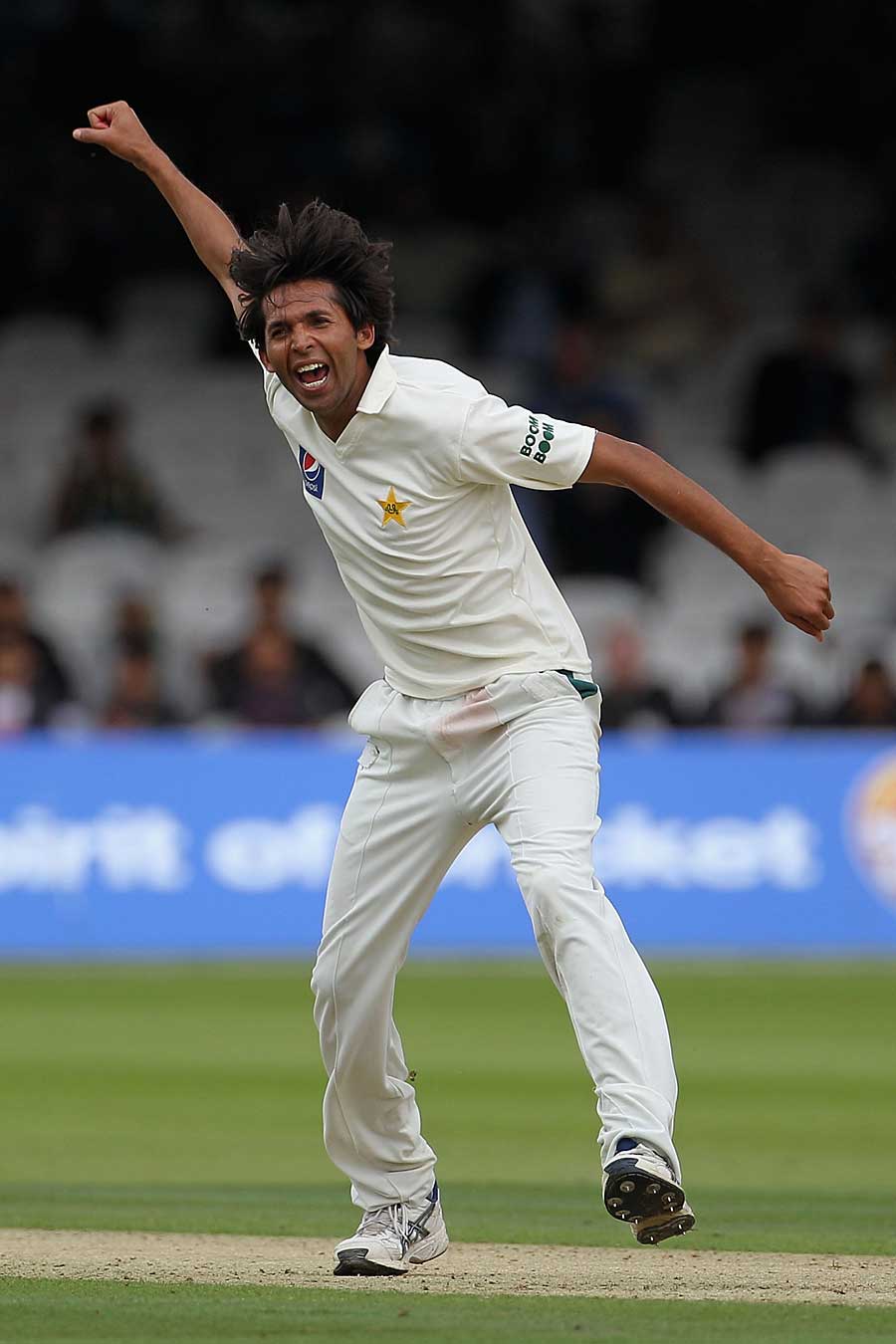
Asif had a brain of real craftsman; who could beat you anywhere in any format of the game. He made the ball to talk in every way possible
16. First maiden in Twenty20 Internationals
Mohammad Asif, Pakistan fast bowler, has distinction of bowling the first ever maiden-over in history of Twenty20 Internationals. On 28th August 2006, Asif bowled maiden over against England in Bristol and also took 2 wickets in that over. Astonishingly, it was also Pakistan’s first ever appearance in Twenty20 Internationals.
Umar Gul; they call him slave of rhythm and king of yorkers
17. Best bowling figures in Twenty20 Internationals
Umar Gul’s 5-wicket haul against New  Zealand in ICC World T20 2009 stands as finest spell bowled in Twenty20 Internationals. He took 5 wickets for 6 runs in his 3 overs, these are best figures by a bowler in Twenty20 Internationals.
18. Best bowling figures in Twenty20 Cricket
In first edition of Indian Premier League in 2008, Pakistan left-arm fast bowler Sohail Tanvir took 6 wickets for 14 runs in a match against Chennai Super Kings while playing for Rajhastan Royals. To date, 4-0-14-6 remains the best bowling figure by any bowler in Twenty20 Cricket.
Stupendous Afridi is a thunderbolt in go!
19. Most Wickets in Twenty20 Internationals
Star Pakistan all-rounder Shahid Afridi leads the way with 53 wickets in 43 T20 Internationals, most wickets, so far, by any bowler in Twenty20 Internationals. He is also the first, and last so far, to take 50 wickets. Second and third are also Pakistanis, Umar Gul (47 wickets in 34 matches) is second whereas Saeed Ajmal (43 wickets in 30 matches) is third.
20. Youngest to take 5-wicket haul and most consecutive 5-wicket hauls in ODIs
Waqar Younis also holds the record for being youngest bowler to take 5 wickets in an ODI. In 1990, at age of 18 years and 164 days, Waqar took 6 wickets for 26 runs in a match against Sri Lanka at Sharjah. Second youngest is also a Pakistani as Wasim Akram, at age of 18 years and 266 days, took 5 wickets for 21 runs against Australia in Melbourne 1995.
In 1990, Waqar Younis also took three consecutive 5-wicket hauls in ODIs. None other than Waqar has taken 5-wicket hauls for three consecutive times. Waqar also took 7 wickets for 36 runs against England at Leeds in 2001, that remains the best bowling figure, in ODIs, by captain.
21. Highest partnerships for first and second wicket in First Class Cricket
Waheed Mirza and Mansoor Akhtar hold the record for highest opening partnership in First Class Cricket, both added 561 as openers in Karachi 1976-77. Record for highest second-wicket partnership also belongs to Pakistan’s pair of Aamir Sajjad and Rafatullah Mohmand; they added 580 for second wicket against Sui Southern Gas Corporation while playing for WAPDA in 2009.
22. Youngest to make Test and ODI Debuts
Hassan Raza, at age of 14 years 227 days, became the youngest player to make play a Test match. He debuted against Zimbabwe in Faisalabad in October 1996. Second and third youngest to make Test debut are also from Pakistan; Mushtaq Mohammad and Aqib Javed made their Test debuts at age of 15 years 124 days and 16 years 189 days respectively.
Hassan Raza, at age of 14 years 233 days, also became the youngest to play an ODI Match. He made his debut against Zimbabwe in Quetta in October 1996.
23. Youngest to score century in ODIs
Shahid Afridi’s maiden ODI century was not only the fastest it was also a century by youngest player in ODI Cricket. Afridi aged 16 years 217 days amassed century of 37 balls against Sri Lanka at Nairobi in 1996. 6 out of top 10 youngest players to score ODI century are from Pakistan.
The young bowler, who was in his new flights, cut his wings himself. He is younget fast-bowler to have 5 wicket-haul in Tests. Miss you!
24. Youngest to take 5-wicket haul in Tests
In 1958, slow left-arm orthodox bowler Nasim-ul-Ghani took 5 wickets for 116 runs, at age of 16 years 303 days, against West Indies in Georgetown. The 5-wicket haul made him youngest bowler to achieve this feat. He was also youngest player to make Test debut at that time.
Moreover, another young Pakistan fast bowler Mohammad Aamir is youngest fast bowler to take 5 wickets in an Test innings. In December 2009, at age of 17 years 257 days, Aamir became the youngest fast bowler and second youngest bowler to take 5 wickets; he took 5 wickets for 79 runs against Australia in Boxing Day Test of 2009.
25. Youngest player to score double-century in Test Cricket
At age of 19 years 140 days, Javed Miandad became the youngest batsman to score a double-century in Test Cricket. In October 1976, Miandad scored 206 runs against New Zealand in Karachi.
26. Youngest bowler to take hat-trick in ODI Cricket
Aaqib Javed at age of 19 years 81 days became the youngest bowler to take hat-trick in ODIs. In Final of Sharjah Cup October 1991, Aqib Javed ripped apart Indian batting and claimed 7 wickets for 37 runs including a hat-trick. Ravi Shastri, Azharuddin and Tendulkar were victims of his hat-trick; all were out LBW. Aqib’s figures of of 7 for 37 were the best bowling figures of that time.
Hanif, the little master, was one of four brothers to play Test Cricket for Pakistan, a world record itself!
27. Only triple-century in second innings of the team
There have been many triple-centuries scored in Test Cricket but, to date, Hanif Mohammad’s 337 against West Indies in Bridgetown 1958 remains the only incident of a batsman scoring triple-century in second innings of the team. In his marathon innings, Hanif Mohammad batted for 970 minutes which is another World Record of longest Test innings played with-respect-to Minutes.
In same match, Pakistan were bowled out on 106 in first innings. In follow-on innings, Pakistan scored 657-8 (declared). The difference of 551 between two innings is the largest difference between a team’s first and second innings; a world record itself.
Now some joint records by Pakistan
28. Highest tenth-wicket partnership in Test Cricket
In 1997 against South Africa, pair of Azhar Mahmood and Mushtaq Ahmad added 151 runs for tenth wicket in Rawalpindi. Azhar Mahmood also scored century on debut in same match. The tally of 151 equaled the record by Hastings and Colling who also scored 151 for tenth-wicket against Pakistan in Auckland 1973.
29. Twin-centuries on Test Debut
Yasir Hameed is the only second batsman to score two-centuries on Debut. He scored 170 and 105 in his debut against Bangladesh in Karachi 2003. Lawrence Rao, of West Indies, is the only other batsman to score twin-centuries on debut; Rao also scored double century in one innings.
30. Maintaining average of 50 throughout batting career
Javed Miandad, along with Herbert Sutcliffe, is the only batsman in Test Cricket whose batting average never fell below 50. Miandad ended his career with batting average of 52.57, scoring 8832 runs in 124 Tests.
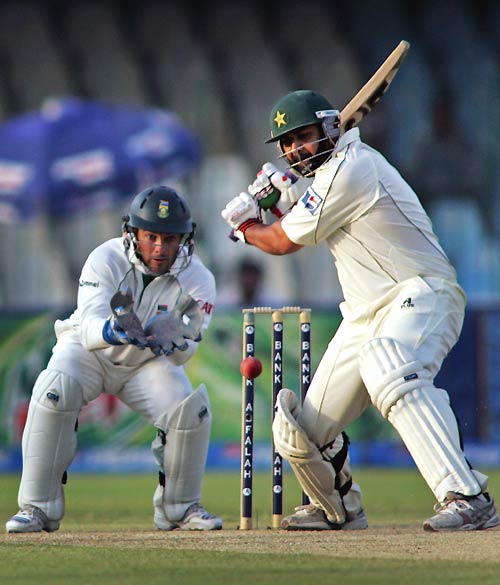
Cut, slice, pull, drive, smash, push, hook, sweep; Inzamam did all of them with his sheer class. Stunning resistor, he was!
31. Five batsmen scoring centuries in a Test Innings
In August 2003 at National Stadium Karachi against Bangladesh, Five batsmen of Pakistan’s batting line-up scored centuries, making it only second instant; first Australia’s five batsmen scored centuries in an innings. Saeed Anwar (101), Tafueer Umar (104), Inzamam-ul-Haq (105), Mohammad Yousuf (102*) and Abdul Razzak (110*) were part of this record.
Written and compiled by: Mazher Arshad [ www.facebook.com/mazher157 ]

Pakistani teen breaks O Level world record

ISLAMABAD: A Pakistani school boy has smashed a world record by getting 23 A grades in his O Levels, taking inspiration from the controversial father of Pakistan’s atomic bomb who is hailed a national hero.
Ibrahim Shahid, 17, the son of a university professor of electrical engineering and educated at the private Beacon House School in Islamabad, set the record last month by achieving 23 As in 24 subjects in the Cambridge exam.
“It’s a recognition for my country. This has never been done at O Level,” he told AFP, dutifully thanking his parents and teachers.
“My teacher in Australia told my father ‘Mr Shahid your son is an average student and he never can excel,’ and then I decided to prove myself,” he said in reference to two years he spent in Australia at primary school.
Shahid has yet to decide what to study at university, but said he is drawn to physics and economics, wanting to do something to help his homeland, teetering on the edge of economic meltdown and beset by poverty.
“I want to do something for my country – something unique,” he said. He confessed to being “worried” about Pakistan, which suffers a critical “brain drain” of talent to the West.
Shahid said he takes inspiration from Abdul Qadeer Khan, widely hailed a hero in Pakistan, but reviled in the West after he confessed in 2004 to selling nuclear secrets to Iran, Libya and North Korea.
Until February 2009, Khan was subject to a house of arrest for operating a nuclear proliferation ring, but Washington says he still represents a risk.
“I’m impressed by Doctor Qadeer Khan. I want to serve my country.
“The future generation has to believe in hardwork. They should not be disheartened. They should work hard to make the impossible possible,” he said.
The Cambridge O Level is an internationally recognised qualification for children aged 14 to 16, as part of preparation for university entrance and before end of school examinations.
It is designed especially for the international market and students whose first language may not be English.
Shahid’s teacher Qurat-Ul-Ain welcomed his achievement as a rare piece of good news and a “message of hope” for Pakistan’s future. – AFP

Friday, 10 June 2011

The Culture of Pakistan

Pakistan, a country in Southern Asia, has a rich culture and heritage. Formerly, a part of 'Hindustan', Pakistan became an independent country on August 14, 1947. The highly traditional Pakistani culture borrows heavily from the cultures of different countries like the Arabs, Greeks, Persians, Aryans, Moghuls and the British. The neighboring countries of Pakistan, like Iran (in the west), Afghanistan (in the northwest) and India (in the east) also influence its culture.

Language
Although, English is widely spoken in Pakistan, Urdu is the official language. The other languages that are spoken in Pakistan are Punjabi, Sindhi, Pushto, Balochi, Hindko, Saraiki, Brahvietc.

Religion
The majority of Pakistan's population are Muslims and they follow the Islamic religion in a strict fashion. They offer namaz (prayers) five times everyday. Ramadan, the most important festival of the Muslims, is also considered as a sacred month. During this month, they fast from morning till sunset without drinking water and are strictly prohibited from smoking and consuming alcohol. The last day of Ramdan is Eid which is celebrated with great fervor with family and friends.

Islam is the major religion in Pakistan, but is not the only one. The minority population comprises of Christians, Buddhists, Hindus and the Persians. Christmas (also the birthday of Ali Jinnah, first governor-general of Pakistan), Jashn-e-Baharan (spring festival celebrated by the Punjabis), Baisakhi Purnima (the birth date of Buddha) and Naoroz (Parsi New Year) are among some of the festivals celebrated in Pakistan.

Architecture
The architecture of Pakistan is miscellaneous, as every nation that invaded and settled in this country has left a mark on it. In ancient times, this Islamic country was a part of the Indus Valley Civilization and the architectures of Mohenjo Daro, Harappa and Kot Diji, are considered as the heritage sites.

One can also see the Buddhist monuments that were constructed during the time when Buddhism was prevalent in Pakistan. The advent of the Moghuls put an end to the Buddhist architecture. During this time, due to the influence of Greeks and Persians, there was an amalgamation of these styles in the architecture of the country which was known as the 'Greco-Buddhist' style.

The invasion of the Mughal empire led to the development of Islamic architecture. The Shah Jahan Mosque of Thatta is the first building that was constructed according to the principles of Mughal architecture. One of the very important monuments that came up during this period is the Badshahi Mosque. It was built during the rule of Emperor Aurangzeb, and is flanked by the magnificent Alamgiri gate.

Later, during the time of colonization, the constructions were majorly of Indo-Western style. Today, in the post-colonial era, we can see a mixture of all these styles along with the modernized structures.

Sports
Although, field hockey is the national game of Pakistan, cricket is a game that is followed with lot of passion. In recent times, even soccer has become popular among the people. The country also internationally represents in sports like swimming, boxing, shooting and athletics.

Art and Literature
Poetry is the most important form of literature in Pakistan. One of the most known exponent of Urdu poetry is Mirza Ghalib. He has written various poems in Urdu and Persian. His poems are still read and loved by Urdu and Hindi speaking people around the globe.

Pakistani literature is not restricted only to Urdu poetry. There is an embodiment of works written in English, Punjabi, Sindhi and Pushto languages. Also, there are Pakistani diasporic writers around the world.

Music is a primary interest of the Pakistanis. Qawwali, which was said to have been introduced by Amir Khusrau, is one of the most traditional forms of music that exists in Pakistan. Film, Urdu and Punjabi pop music is also popular among the people. Nowadays, it is blended with western music and this amalgamation has developed into a popular music genre.

The most popular entertainment medium in Pakistan are the television and the radio. Pakistan's film industry is referred to as Lollywood with a production of 40 motion pictures every year. Indian movies are also popular in Pakistan, although, it has been banned by the Government of Pakistan.

Social Culture
The Pakistanis are mostly conservative in nature. They follow a strict code of conduct. They live in a patriarchal family where the eldest male member is the head of the family. The elders are given lot of respect and their opinions are regarded with utmost importance while taking important decisions.

Although education is considered as a very important factor among the middle class people, most Pakistani women are not given the freedom to work. But nowadays, many joint families are disintegrating into nuclear families due to the social and economic limitations that are enforced by the joint family system.

Pakistan, is a country, that adheres to its traditional beliefs, values and customs especially in matters of religion. Although, the Pakistanis are deeply rooted in their cultural values, the nation is not lagging behind, with globalization affecting every part of the world. Westernization has embarked into the Pakistani culture which has paved the way for positive development.

Tourism in Pakistan

Pakistan is a rich and varied country in its own right. It is ancient and modern also. Besides the several historic and cultural sights that Pakistan has to offer, there is geographical and environmental diversity that makes Pakistan truly a destination for all seasons. Indeed Pakistan today presents a rich mosaic of nearly 60 centuries of continuous, eve changing history and culture in settings which range from the beaches of Karachi to the deserts of Thar and Cholistan, and from the green plains of the Punjab to the majestic and challenging mountains of the Hindukush, Himalayas and the Karakoram ranges. And then there are the cities, Peshawar, Lahore, Multan and Thatta, the folkloric histories of which have the ability to charm both the casual tourist as well as the visitor with special interest. The rich diversity that Pakistan offers the visitor is evident as you travel within Pakistan.

Visitors to Pakistan have often noted that in some places of the country you get the feeling that time has come to standstill since ages. In the gently undulating foothills of the mighty Karakorams and in the middle reaches of the towering Hindu Kush Mountains, there is a timeless beauty that is hard to surpass elsewhere. In these two mountain ranges you can experience a Pakistan version of the mythical Shangrila.

It is in these mountains that you have Gilgit, linked with China, in ancient times and in new, by the fabled Silk Route, the world’s highest oldest and toughest mountain road. This road was used for centuries by caravans from China which carried fabulous silk and other oriental merchandise to Arabia and Europe, Gilgit is also the place where the game of polo was born. Centuries ago it was played there at night with balls of fire. Today it is still played there at more or less the same site it has been played at far all these years. In these ranges too is Nanga Parbat, which at 26000 feet is one of the highest peaks in the world. Here too is the Khyber Pass, the route that most foreign invades used to enter the subcontinent from the North. Through this pass came at one time or another the might Mongols, the Turks, the Huns the Moghuls, and other.

The sense of history does not end there. In the foothills town of Chitral you will find that the inhabitants are the descendants of the Macedonians that rode with Alexander the Great when that great conqueror led his armies through the plains of Pakistan centuries ago. Here you will see the Kafir Kalas, called many a pagan tribe because they practice ancient Greak prayer rituals. But after a single look at the Kafirs you will say that this is the legendary land of health and beauty their unlined faces are just as serene at seventeen as at seventy. And all of this can be observed against the majestic backdrop of the 25290 feet high Trichmir Peak.

The reason that these regions in the north of Pakistan are said to be beyond the reach of time is that they are snowbound for most of the years, so modern life has not affected the way of life. In fact most of the inhabitants have not seen the outside world at all. Even the dialects they speak are all but extinct. To be there is indeed to take a trip beyond time, into land of great natural beauty and splendor.

Over the centuries the land that is now called Pakistan has been the cradle of many civilizations. The ruins at Harappa and Mohenjodaro are evidence of the high level of civilization of the people who lived there almost 5000 years also in the down, as it were of human history. Several centuries later, the Greeks led by the indomitable Alexander, left their footprints – indelibly as it turns out in the sands of north of Pakistan.

Soon after Alexander came the rise to prosperity of the great Gandhara civilization, an ear devoted mainly to Buddhist art and architecture. And with the passing of those years came Muslim rule of the subcontinent and the majestic grandeur of the Mughals.

They build the Badhahi Mosque, laid out the exotic Shalimar Garden and erected magnificent mausoleums for their families and the loved ones.

Traveling through Pakistan today, one can easily pick up the threads of history . One can experience it in the museums, the ruins, the shrines and bazaars. And can relive it in the stories and legends that still surround these places of beauty. In Karachi for instance, one could visit the Mausoleum of Quaid-e-Azam the founder of the Nation of PAKISTAN.

The mausoleum is built entirely of white marble, it has an impressive dome that holds a huge crystal chandelier of Chinese origin. Then there is the quaint Bohri Bazar whole narrow streets and yelling hawkers make an unforgettable sight. And you should not leave Karachi with out visiting National Museum, whole Gandhara Art collection is said to be the finest in the world. Then you could visit Moenjodaro the ‘ Mound of Dead ‘ which was discovered in 1922 and opens up a fascinating window of life of the people who lived there around 2000 B.C.

Old Persia comes to life in Lahore, at the Shalimar Garden designed by the Persian land-escapist Ali Mardan, There are marble pavilions, a marble waterfall and more then 400 fountains, all in area of 42 acres. Emperor Shah Jahan ordered the construction of this Garden of Heaven in 1642 . Also in Lahore is the Anarkali Bazar, named after a pretty dances who was put to death by Emperor Akbar for having an affair with his son Prince Salim, who later became the Emperor Jehangir. Jehangir’s tomb is also in the city as is Wazir Khan’s Mosque which was constructed under the stewardship of the Governor of Lahore in 1643. But the most rewarding sight of all in Lahore is probably Lahore Fort a marvel of Mughal architecture begun in the 11th Century and completed finally by the end of the 16yth Century. Among the emperors who contributed to its splendour were the emperors, Akbar, Jehangir and Shah Jehan. Here too is the beautiful Palaces of Mirrors, Shah Jehan’s quadrangle, and the pearl Mosque.

Overlooking the fort is the Badshahi Mosque the world’s largest which was constructed during the reign of Emperor Aurangzeb. Pakistan famous poet-philosopher Dr. Mohammad Iqbal lays buried outside the mosque.

Some 18 mile from Rawalpindi is the ancient seat of Oriental culture, Taxila. It was first mentioned in the literature as a satrapy of the Achemenian empire in the 6th century B.C. It was later invaded by Alexander the Great and passed through the control of subsequent rules until it came under the rule of Ashoka the Great, who molded the city into a center of learning philosophy and art. The city prospered during the creative Gandhara period that followed shortly after, but came to a catastrophic and pathetic end when it was attacked by the White Huns.

Today Taxila is a archaeologist’s paradise with a museum and historic sites scattered within a radius of a few miles. In Pakistan today one can indeed relive the past, transport oneself into bygone era of great kinds who were both warriors and philosophers, men in whole lifetimes rich and majestic histories unfolded. Sand not only is the visitor hound to the spellbound by the stories of the past, he will also be overwhelmed by the splendid natural beauty of the countryside which can be tranquil at times and awe-inspiring at others.

Thursday, 2 June 2011

Pak engineer wins global recognition

A dynamic Pakistani, Amir Davis, a proud member of Christian community, has been declared Global Hero of Intel Corporation, a multinational technology company, for his inspiring struggle to impart education to the underprivileged Pakistani youth.

The award is given to one of the company’s employee who in addition to his office duty, works for a distinguished volunteer cause with great impact on people’s lives.

Before Amir received honour, two Pakistani girl students, Mehwish Ghafoor and Ambreen Bibi, won Third Place Grand Award at the Intel International Science and Engineering Fair in the United States.

Amir stood out of 10 contestants short-listed for the Global Hero Award. There were 150 entries this year across the world and 10 of them were short-listed. All of these 10 semi finalists were awarded with $2500 by Intel for their causes and the winner, Amir, grabbed an additional $10,000.

“You are being recognized for your commitment to improving education in Pakistan, by personally establishing a rural village primary school. Your volunteerism with this project stood out as an outstanding example of volunteering at the highest level,” said a statement of Intel Corporation, paying tribute to the winner, Amir.

Amir who works as a database administrator in the company’s Ireland office returned the compliment and said: “I don’t want to see the next generation facing the same cruelty caused by poverty and eventually being involved in child labour.”

He is managing the education of 161 children of up-to five grades with a paltry amount and now planning the school’s up-gradation with extra money he raised through private donations.

Tuesday, 17 May 2011

Pakistani students win prize in Intel science fair

Pakistani students win prize in Intel science fair


(L) Mehwish Ghafoor and (R) Ambreen Bibi has won the third place in Grand Prize in the field of environmental science at ISEF, United States. Each received $ 1,000 for developing a treatment that utilizes nanotechnology to make polluted water drinkable. – File Photo by Suhail Yusuf / Dawn.com

LOS ANGELES: Young Pakistani students used Nanotechnology to clean polluted water and won Third Place Grand Award at the Intel International Science and Engineering Fair in the United States.
An announcement here on Saturday said that Ambreen Bibi and Mehwish Ghafoor of Islamabad won a Third Place Grand Award in the field of Environmental Sciences.
It said that they received the award and $ 1,000 for developing a treatment that utilizes nanotechnology to make polluted water drinkable.
Matthew Feddersen and Blake Marggraff from Lafayette, California were awarded the top prize. They received $ 75,000 and the Gordon E. Moore Award for developing a potentially more effective and less expensive cancer treatment that places tin metal near a tumor before radiation therapy.
Taylor Wilson from Reno, Nevada, was named an Intel Foundation Young Scientist Award winner and received $50,000. Taylor developed one of the lowest dose and highest sensitivity interrogation systems for countering nuclear terrorism.
‘We champion the Intel International Science and Engineering Fair because we believe that math and science are imperative for innovation’, said Naveed Siraj, Country Manager, Intel Pakistan.
‘This global competition features youth trying to solve the world’s most pressing challenges through science’.
This year more than 1,500 young entrepreneurs, innovators and scientists were selected to compete in the International Science and Engineering Fair, the world’s largest high school science research competition.

Pakistani students shortlisted for international software competition

ISLAMABAD: A group of students from FAST National University of Computer and Emerging Sciences, Islamabad have been shortlisted from Pakistan to participate in the final round of Imagine Cup, USA.
The cup is the world’s largest premier students’ technology competition, which brings together young technologists worldwide to help resolve some of the world’s toughest challenges. The Pakistan finals were organized at Microsoft Head office in Pakistan.
Around 2000 students registered in Imagine Cup from Pakistan and around 50 teams competed in the Software Design Category. Out of these 50 teams, top 4 teams were shortlisted by a panel of judges from both technical and business domains. Team V3C from FAST university secured the first position.
“Imagine Cup is a unique platform to tap the imaginative talent of young minds by giving them an opportunity to think out of the box and solve the toughest problems faced by the society today. I am particularly excited about the projects these students have developed to enhance the computing experience of people. I am sure these talented students will make us proud,” said Kamal Ahmed, Country General Manager, Microsoft Pakistan.
Talking about the competition Tahir Masood of KalSoft expressed, “It is inspiring to meet so many students who are on the forefront of new discoveries, whether they go on to develop a breakthrough and solve real world issue, start a new company or become better prepared to enter the workforce, students who participate in the Imagine Cup are leading us into a brighter future”.
“I am grateful to Microsoft for providing us the opportunity to showcase our potential. We all are very excited about the worldwide finals and consider this as a great responsibility that we will be representing Pakistan and will surely do our best to raise our Country’s flag in the global finals” said Hussain Sajjad, Team leader V3C.
The winning team V3C will be fully sponsored by Microsoft to represent Pakistan in the finals which will be held in the month of July 2011. Before competing in the worldwide finals the teams will also receive some expert guidance and mentorship from the local industry experts to improve their presentation skills and product design.

Great achievements

It gave me great pleasure to learn about the achievement of Hasan Sadpara, the second Pakistani to reach the summit of the world’s highest peak, that of Mount Everest. He is the only Pakistani to conquer all the five peaks in Pakistan which are more than 8000-metre high.

It is great news for the people of Pakistan especially in these times of despondency. Hasan Sadpara’s accomplishment will definitely boost the moral of the nation. Well done, Hasan Sadpara. The nation is proud of you.

Dr Abdul Hadi

Swat


*****

We are proud of the two Pakistani students who got the third prize at Intel International Science and Engineering Fair held in the US. They developed a treatment which utilises nanotechnology to make polluted water drinkable.

I wonder if they will be rewarded in Pakistan in the same way in which our cricketers are rewarded.

Dr Saeed

Islamabad

The galaxy of Pakistani scientists


Famous Pakistanis – Scientists

    Dr. Munir Ahmed Khan

    Dr. N.M. Butt

    Dr. Abdul Qadeer Khan

    Dr. Tahir Hussain

    Dr. Samar Mubarak Mand

    Dr. Ishrat Hussain Usmani

    Dr. Sakhi Mohammad Bhutta

    Dr. Ashfaque Ahmad

    Professor Dr. Abdus Salam

    Dr. Rafi Mohammad Chaudhary

    Dr. Aurangzeb Hafi


Dr. Munir Ahmed Khan [1926-1999]

On January 20, 1972, late Zulfiqar Ali Bhutto called on a number of leading scientists at Multan and expressed his desire to go for a Nuclear Bomb. How much time would you take for it asked the Premier. A few comments came up which did not satisfy the Premier. “I shall need three years and give you the bomb said one of the scientists. This challenge changed the mood and the Premier got excited and said abruptly. “Is it possible”? Yes of course, was the sharp answer with confidence from the one who had accepted to take up the challenge. “We will eat grass but we must have a bomb” said the premier. We have wasted a lot of time. We could go for it in 1965. Still much is not lost, we should put our heads down and work ceaselessly for it” said the Premier.

Next day, Bhutto entrusted this Himalayan task to Dr. Munir Ahmed Khan appointing him Chairman of Pakistan Atomic Energy Commission. This was in 1972. Dr. Munir continued as Chairman till 1990 when he retired having built the Commission a strong organization that ultimately showed its worth in May 1998.

Dr. Munir Ahmed Khan was born in 1926 at Qasur in a modest educated family. After initial education at his native place he moved to Lahore where he matriculated in 1942 in Central Model High School. In 1944, he did his FSc and BSc in 1946 from Government College, Lahore.

He became Electrical Engineer in 1949 qualifying from the Engineering College, Lahore. For some time, he taught at the Engineering College and proceeded to America on a Fulbright Scholarship and joined North Carolina University from where he did MSc in 1951. He specialized in Nuclear Engineering from the University of Science and Technology, Chicago.

Having visited Austria in 1957 and working for some time, at International Atomic Agency, Vienna, he returned home in 1971 and joined AAEC as a scientist and elevated himself as its Chairman the following year.

During his stay as the Chairman for about eighteen years, though according to his challenge he could not produce the bomb, but he can be credited for having laid the first brick to this end by strengthening the Atomic Energy Commission which ultimately achieved its target. “He helped Pakistan acquire industry for complete nuclear fuel cycle involving uranium exploration, mining, making of uranium metal and culminating in fuel bundles for nuclear power reactors.”

It also goes to his credit that he raised a capable team of scientists like Dr. Ashfaq, Bashirudin Mahmood, Dr. N.A. Butt and others. He contributed in the development of Science and Technology by way of associating himself in the establishment of various research and teaching organizations including PINSTECH and Centre for Nuclear Studies. Imitation of Nuclear Re-actor at Jauharabad and foundation of National Development Complex are additional feathers in his cap. The cold test of Atomic Programme in March 1983 was made under his supervision. Although he retired from the PAEC in 1991, yet he remained associated with the Nuclear issues throughout: “He spent nearly forty years in the atomic energy, half in training in the US nuclear establishments and in working in the International Atomic Energy Agency in Vienna and other half in applying that expertise and knowledge in the development of Pakistan Nuclear programme.”

He has published many research articles in different international journals. He was given awards of distinction by the Government of Pakistan. This scientist who first of all spoke to produce Atomic bomb expired on April 21st, 1999.

“Dr. Munir’s achievements must be seen in the background of anti nuclear international environment of past two decades when the United States, Canada and European country passed domestic legislation to not only place restrictions of transfer of technology but even to negotiate settled contracts.”

Source:

Prominent Scientists of Pakistan (Urdu)
Khalid Mahmood Asim
Articles

The Nuclear Father

The fifth death anniversary of Mr. Munir Ahmad Khan, Chairman of the Pakistan Atomic Energy Commission (1972-1991), who developed and led Pakistan’s nuclear programme for two decades and who achieved international recognition as a nuclear expert and advocate for the Third World is marked on April 22..

He spent his last days of illness in Vienna, Austria, where he enjoyed a distinguished tenure with the International Atomic Energy Agency (1957-1972). He was one of the first Asian scientists to join the IAEA, and rose to become director of the Reactor Engineering Division and Member of the Board of Governors, and was elected Board Chairman in 1986-87.

It was while he was still with the IAEA that Prime Minister Zulfiqar Ali Bhutto requested him to return to Pakistan as PAEC Chairman at the famous Multan Conference of senior scientists, where the foundations of the nuclear weapons programme were laid. It was a historic move as Pakistan thereafter embarked on a crash program to develop the atomic bomb, and he as the architect of the nuclear programme would make this dream come true by 1983 when PAEC conducted its first successful cold tests.

Under Munir’s dedicated leadership, Pakistan’s nuclear programme developed into a multi-faceted and dynamic center of science and technology, both on the peaceful and deterrence sides. He established the blueprint and developed the know how for Pakistan’s weapons capability. This includes the fuel and heavy water fabrication facilities, uranium enrichment and plutonium reprocessing facilities, nuclear fuel cycle facilities, training centres and nuclear power reactors.

In addition, the PAEC made formidable strides by developing new strains of rice and cotton that added billions to Pakistan’s agricultural output. Nuclear medical centres across the country have treated hundreds of thousands of cancer patients. Recently a long-standing dream of his was achieved with the elevation of the Centre for Nuclear Studies into an internationally recognised university. He established CNS as a centre of excellence, to provide the critical element of any nuclear programme, the trained manpower, which has so far produced over 2000 world-class nuclear scientists and engineers, at a time when the Western universities refused to allow Pakistanis into the nuclear field.

He initiated the Kahuta Enrichment Project, as Project-706, under Sultan Bashiruddin Mahmud, in 1974, two years prior to A.Q. Khan’s arrival in Pakistan. He completed the feasibility study, site selection for the plant, construction of its civil works, recruitment of the staff, and procurement of the necessary materials by 1976.

The PAEC under Munir remained in charge of the overall bomb programme, of all the 23 out of 24 difficult steps before and after uranium enrichment, and he continued to provide technical support to the enrichment program all along. The PAEC under him went on to develop the first generation of nuclear weapons in the 1980s. Munir started work on the bomb itself in a meeting called in March 1974, in which the secret ‘Wah Group’ was assigned the task of initiating work on it, prior to the arrival of A. Q. Khan in Pakistan.

The Chaghi tunnels were constructed under him and were ready by 1980. Munir successfully conducted the first ‘cold’ tests in March 1983, and the 1998 ‘hot’ tests were their confirmation. He made Pakistan acquire complete mastery over the nuclear fuel cycle, which is critical to the development and success of any nuclear programme.

The fuel cycle ranges from mining (uranium ore mining from mines), milling (uranium ore into yellow cake), conversion (yellow cake into hexafluoride gas, the crucial ingredient for uranium enrichment through the ‘gas’ centrifuge method used in KRL). Fuel fabrication (converting enriched uranium into uranium dioxide, sealing it into metal fuel rods and bundling into fuel assembly as fuel for nuclear power plants) was accomplished by PAEC under Munir.

Uranium enrichment would have been impossible without the hexafluoride gas, and mastery of the nuclear fuel cycle, which was accomplished by Munir. The highly enriched uranium is then converted into metal at PAEC and then into bomb cores, which itself involves very critical technologies, which were as great a challenge as uranium enrichment or plutonium reprocessing. Munir had laid solid groundwork for all these technologies, which enabled Pakistan to acquire nuclear capability by the early 1980s.

When in 1976 Canada suspended the supply of heavy water fuel and spare parts for the Karachi nuclear power plant, he took up the challenge and using indigenous resources produced the Feed for KANUPP, which is why the Muslim world’s first nuclear power plant is still running successfully.

He also upgraded the research reactor at PINSTECH and laid the groundwork in the 1980s for the 300 MW nuclear power plant at Chashma. Munir also laid the foundations of the National Development Complex, under Dr Samar Mubarikmand. Today NDC is a vital strategic organisation.

PAEC under Munir was also actively developing the plutonium programme, in spite of the cancellation of the French reprocessing contract, and went ahead with developing an indigenous pilot reprocessing plant, which was completed by 1981, known as the ‘New Labs’ in PINSTECH. The PAEC did not forego the plutonium route, and was successful at developing the indigenous plutonium production reactor at Khushab, commissioned recently. This was driven during Munir Khan’s 19-year tenure. Plutonium is used to develop advanced compact warheads, and makes more powerful bombs than uranium.

Munir was very modest, and shied away from the counter-productive boasting of his rivals. He saw Pakistan’s strength as lying in more than having a bomb, as equally dependent on a secure economic and political future and non-isolation in the world.

As he developed the PAEC programme, so too did he grow in international stature as one of the leading nuclear policymakers to represent Third World interests at international forum. A few years prior to his death, he was made Advisor on Science and Technology at the Islamic Development Bank to assist in developing their investment in the sciences in Muslim countries.

Munir Khan did his BSc from Government College Lahore as a contemporary of the late Nobel Laureate Dr Abdus Salam. He later went to the USA on a Fulbright Grant and Rotary International Fellowship where he earned a Master’s in electrical engineering from North Carolina State University and an MSc in nuclear engineering from Argonne National Laboratories in Illinois as part of the Atoms for Peace Programme.

Munir’s vision for Pakistan, and indeed the whole Muslim community, as a centre for science and technology, was an inspiration to scientists and colleagues around the world. The strict controls in PAEC from the time of Munir becoming Chairman in 1972 ensured that no financial bunglings or material ‘leaks’ would take place.

He was an example of how a scientist in a very senior and responsible position could behave with the utmost responsibility and secrecy in matters of supreme national interest. He was a man who was obsessed with secrecy, and believed that national security must be above personal whims and wishes, and abhorred personal aggrandisement. He spoke rarely to the press, and only in public, never in private, and he refrained from all self-projection and never indulged in cheap popularity stunts.

He never let any journalist in his office or residence, nor did he crave their attention. For all his sense of responsibility throughout his Chairmanship, he had to pay a personal price by remaining unsung. Some believed that keeping silent was a mistake, and that the people would never know of the accomplishments of the PAEC and his own contribution. He was deeply humble, impeccably honest and humane, an avid conversationalist who in the traditions of most nuclear scientists, was a connoisseur of arts, especially literature and Urdu poetry, particularly Ghalib, Iqbal and Faiz. And like most nuclear scientists engaged in changing the destiny of nations, he used to have long walks. He was a consummate conversationalist and burst into laughter without prodding. It was amazing how he had compartmentalised his mind. Manager of a colossal and highly sensitive nuclear programme, he talked of other things in the world without even giving a hint about his identity. His confidence and patriotism did not allow him to divulge his secrets to any man who did not belong to his trade.

With superabundant energy, iron will, and an intense patriotic zeal, he became a lodestar in the history of the nation. He was known as the ‘Father’ in PAEC circles, yet he remains an unsung hero whose contributions are largely unknown, and unacknowledged. His predecessor, Dr. I. H. Usmani, got the Nishan-i-Imtiaz posthumously after the 1998 nuclear tests, as did his successor, Dr Ishfaq Ahmed, yet he continues to be left out.

His detractors have been exposed in the recent proliferation scandal, and he stands vindicated. He remained associated till his last day in Pakistan with nuclear issues and continued to serve the country by sharing his rich 42-year experience in the nuclear field with PAEC even after retiring as Chairman in 1991. His greatest legacy is that he made Pakistan a nuclear power by making the nuclear programme independent of his self. Yet even five years after his death, he remains an unsung hero who along with his team of dedicated scientists and engineers enabled us to safeguard our honour as a nation. Justice requires that the falsification of history be rectified. The nation for which he lived his life, deserves to know the truth.

Courtesy:

The Nation, April 22, 2004 (By M.A. SHEIKH)

BACK


Dr. N.M. Butt

Dr. N.M. Butt is from amongst the very few in Pakistan who attained DSc the highest degree of Science. He also has the distinction of being the first Pakistani to obtain this degree.

Dr. Butt was born at Lahore in 1938. He did MSC in Physics with distinction from Government College, Lahore. He got associated with Pakistan Institute of Nuclear Science and Technology (PINSTECH) and in due course of time proceeded to England for higher studies. He joined Department of Nuclear Physics, Birmingham University, where he earned the degree of D.Sc. Thereafter, Dr. Butt re-joined PINSTECH and worked on important posts such as Chief Scientist and retired as Director General in 1998. He was made Scientist of Emeritus in this Institute to which he is still attached.

He is fellow of Royal Society of Physics, London and Fellow of Islamic Academy of Sciences. Dr. Butt has published far numbering research articles in national and international research journals and has trained a fairly large number of young scientists. He was conferred with Sitara-i-Imtiaz by the Government of Pakistan.

Source:

Prominent Scientists of Pakistan (Urdu)
Khalid Mahmood Asim

BACK


Dr. Abdul Qadeer Khan

Dr. Abdul Qadeer Khan, Pakistan’s nuclear hero is a scion of Bhopal state’s modest and a religious family. He was born in April 1936. His father Abdul Ghafoor Khan was an academician who retired from Education Department in 1935 and settled permanently in Bhopal. In 1952, Qadeer did his Matriculation and same year in the month of August, he migrated to Pakistan. At Karachi, he did his FSC from D.J. Science College and graduated from Karachi University. He proceeded to Germany in 1961 on a scholarship for higher studies in Metallurgy. In 1963-4, he moved to Holland and did his MSC with distinction in Physical Metallurgy from Technological University Defolt. In 1968, did his Doctorate in the same subject from Catholic University of Leon. In 1972, started his career as a Metallurgist at Physical Dynamic Research Laboratory (F.D.O) at Amsterdam. This gave him an opportunity to move onwards from an ‘unknown to a known’ that later made it possible for him to go for a big hunt in Nuclear Science. Before returning home in 1976, he had worked at the British, German and Dutch Urenco uranium enrichment facility in the Netherlands in the early seventies.

During Premier Bhutto’s regime he was entrusted with the job to organize Pakistan's nuclear programme that could give an answer to India in a befitting manner. He thus sowed real seeds of Pakistan’s nuclear programme on July 31 1976, when 'Engineering Research Laboratories', an autonomous organization was formed headed by Dr. Qadeer Khan who later emerged as an architect of Pakistan’s Nuclear prowess and also called as the father of Pakistan medium-range Ghauri and other Missiles.

Needless to say that credit goes to the great Khan that "in a record short span of six years, Pakistan was put on the nuclear map of the world and a solid foundation was laid for our self-sufficiency in future of the peaceful uses of nuclear energy."

‘He became the focus of attention after India exploded three nuclear devices on May 11 and two more on May 13, 1992 to which Pakistan gave an appropriate answer by exploding five Pakistani nuclear blasts on May 28, 1998 and at least one on the following day - a move that spurred jubilation at home and condemnation abroad, coupled with sanctions.’

It may be noted that Dr. Qadeer Khan was levelled with fake charges of nuclear espionage by the West so much so that a court in Amsterdam sentenced him in absentia in 1983 for four years in jail. Dr. Qadeer refutes much biased allegations of engaging forcefully himself in any sort of nuclear espionage. The court, however, later on, withdrew it’s baseless allegation when the Khan fought his case with vigour and determination.

The great Khan, the great hero, the great architect of Pakistan’s Nuclear technology deserves special gratitude of the people of Pakistan. We salute him.

Source:

Prominent Scientists of Pakistan (Urdu)
Khalid Mahmood Asim


BACK


Dr. Tahir Hussain

Amongst the first scientists who taught and researched in nuclear Physics, and produced brilliant scientists about whom he remarked: "From the theory that I taught, my students produced results " it was not an easy job but a colossal task which only unique people could perform and they did wonder”. Dr. Tahir worked with Dr. Rafi in the first Nuclear Research Laboratory and trained a number of young scientists.

He was educated at Aligarh University where he did his MSc with distinction. He accompanied Dr. Mohammad Rafi Chaudhary when the later came to Pakistan in 1948 at the invitation of the Quaid-i-Azam Mohammad Ali Jinnah. At first, he taught Physics at Government College, Lahore, and after some time, proceeded to Oxford University and did PhD in Nuclear Physics. After returning to Pakistan, rejoined Government College, and was elevated to the post of Chairman of the Department of Physics. While he was at Government College, Dr. Tahir was appointed Vice-Chancellor of Azad Kashmir University, Muzaffarabad. Thereafter, he was appointed Chairman, Literacy and Mass Education for some time. Dr. Tahir was associated with the Ministry of Education as Consultant for Science and also worked as Chairman, USA Education Foundation. He has published a number of research papers in journals of international repute.

Dr. Tahir Hussain has contributed in the foundation and development of the first Nuclear Research Laboratory. In the High Tension Laboratory, scientists like Dr. Mand, Dr. Ishfaq, Dr. Mansoor and others worked under his supervision.

Source:

Prominent Scientists of Pakistan (Urdu)
Khalid Mahmood Asim

BACK


Dr. Samar Mubarak Mand

Dr. Samar Mubarak Mand, is one of the architects who have made Pakistan the first Muslim country in the world to posses a nuclear bomb. “It was the result of the efforts made by thousands of scientists and engineers” who deserve the entire nation’s gratitude.

Mand belongs to an educated family of Rawalpindi where he was born in 1941 and in the same city matriculated in 1956. Thereafter, did his FSC in 1958 from Government College, Lahore; BSC in 1960 and MSC in 1962 - attaining distinction in all of these with academic roll of honour.

He started his career as a scientist in 1962 in the Pakistan Atomic Energy Commission. It was during this job that he proceeded to England for higher education and did his PhD in Experimental Physics (Nuclear Physics) from Oxford University. He returned in 1966 to Pakistan and again joined AAEC. He entered into matrimonial life in 1968 and was married to a lady who herself is a scientist and a teacher. In 1974, he joined Pakistan Institute of Nuclear Science and Technology and worked there on different important posts such as Director, Member Technical and Director General.

Besides his official assignments, he remained active in contributing to higher level research and published a number of research articles in journals of international repute.

He led the team of scientists who took up the nuclear task of explosion on May 28, 1998. Recalling the crucial moments he said: "My eyes were set on the mountain in which the test was to be conducted. I experienced a halt in my heartbeat on seeing nothing happening after 32 seconds. But all of a sudden it was a big jolt! We had triumphed.”

The credit of Shaheen Missile also goes to Dr. Mand and his enthusiastic team of scientists. In lieu of his meritorious services to the country, Dr. Mand was conferred with Sitara-i-Imtiaz and Hilal-i-Imtiaz by the Government of Pakistan.

Source:

Prominent Scientists of Pakistan (Urdu)
Khalid Mahmood Asim

BACK


Dr. Ishrat Hussain Usmani

Dr. Ishrat Hussain Usmani, (I.H.Usmani) who laid foundation of Pakistan Institute of Nuclear Science and Technology was born on April 15, 1917 and educated at Bombay University where he did his BSc (Hons) in 1937, MSc in 1938 and PhD from London University. In 1942, Dr. Usmani joined Indian Civil Service and migrated to Pakistan in 1947 and continued to wok as a Civil Servant in the newly created country on different important posts for five years.

Dr. Usmani worked as Adviser Science to the President of Pakistan. Later, in 1960, he was appointed Chairman, Pakistan Atomic Energy Commission which he headed till 1972. During his tenure as chairman, he engaged and trained a number of young scientists who later played pivotal role in the advancement of Nuclear Technology in Pakistan. He was the one to have laid foundation of PINSTECH and initiated Karachi Nuclear Power Plant that became functionary in 1972. At Faislabad, an Institute called Nuclear Institute for Agriculture (NIAB) was also established by Dr. Usmani. Likewise, he was responsible for establishing Nuclear Research Institutes for Medicine, Industry and Mineralogy at different cities such as Karachi, Lahore, Tando Jam, Dhaka, Chittagong and Memon Singh. It was at his initiation that a separate Ministry called the ‘Ministry of Science and Technology’ was created by the Government of Pakistan in 1972. Establishment of the Pakistan Foundation was also one of his achievements.

Dr. Usmani remained Senior Adviser for Nuclear Technology in UNO for eleven years. He has published a good number of research papers in quality research journals of international repute. He was conferred with Sitara-i-Imtiaz by the Government of Pakistan. Dr. Usmani departed on June 18th, 1992.

Source:

Prominent Scientists of Pakistan (Urdu)
Khalid Mahmood Asim

BACK


Dr. Sakhi Mohammad Bhutta

He is the one who made a rich contribution in the growth and development of Pakistan Atomic Energy Commission by way of providing tremendous financial assistance through industrialists of Chaniot especially well known “Triple As”.

Dr. Bhutta’s contribution is two-fold-one as a scientist and the other as a source person responsible for drawing finances for the PAEC during its initial stages.

Dr. Bhutta belongs to Chaniot, District Jhung where he was born in 1941 and later completed his early education up to FSc in 1958 from his native city. He did BSc Engineering from Engineering University, Lahore, in 1961 with a distinction that made his way for a scholarship from International Atomic Energy Agency. This made it possible for him to proceed to America for higher studies and in 1964, he did is MSc in Nuclear Engineering from the University of Michigan.

After completion of his education, he returned to Pakistan and joined Karachi Nuclear Power Plant where he was elevated to the post of Director in 1965. In 1972, he was appointed its head where he worked till 1973. Later on, Dr. Bhutta was appointed as Senior Adviser of National Electrical Power Regulatory Authority, where he is still associated.

Source:

Prominent Scientists of Pakistan (Urdu)
Khalid Mahmood Asim

BACK


Dr. Ashfaque Ahmad 

The first Atomic Explosions of May 28 and 30, 1998 were done under his supervision since he was the Chairman of Pakistan Atomic Energy Commission to which he remained associated since its inception.

Dr. Ashfaque belongs to Lahore where he completed his education from Government College. It was in 1951 that he did his MSc with distinction with roll of honour. In 1952, he began his career as a teacher at Government College, and later, went to Canada and obtained the Degree of Science from the University of Montréal. He worked in Research Laboratories in Denmark and France. After his return to Pakistan, he joined Pakistan Atomic Energy Commission in 1960 being among the first scientists to have joined this Commission under the chairmanship of Dr. I.H. Usmani.

Dr. Ashfaq worked in different capacities and continuously for thirty one years, remained associated with the National Nuclear Programme. He became its Chairman in 1991. He has published quality research papers in reputed Journals of national and international repute. Only recently, he has been elected member of International Nuclear Energy Academy (INEA). His membership of this Academy is not only an honour for Pakistan but for the entire Islamic World as well. He has been conferred with several awards including Sitara-i-Imtiaz; Hilal-i-Imtiaz and Nishan-i-Imtiaz.

Source:

Prominent Scientists of Pakistan (Urdu)
Khalid Mahmood Asim

BACK


Professor Dr. Abdus Salam [1926-1994]

Professor Abdus Salam one of the greatest exponents in physics of this century was born in a modest family of Jhang, in 1926. His father, Chaudhary Mohammad Husain served in Education department, Jhung. Salam received his early education in his native city doing Matric in 1940 and FSc in 1942. In 1944, he did BSc from Government College Lahore. He did MSc in 1945 and also attained MA Degree in Mathematics in 1946, Thus, Salam, has the credit of being double MA (Physics & Mathematics) at the age of only 20 years which is a record in the University of the Punjab, Lahore.

He proceeded to England in 1946 for further studies where he was educated at St. John’s College, Cambridge and Cavendish Laboratory, Cambridge where he stayed for a period of three years (1946-1949). After becoming a Wrangler in double course of Physics and Mathematics returned to Pakistan in 1951 and served in the Government College, Lahore and University of the Punjab between 1952-54 as a teacher and Head of the Department of Mathematics. The year 1951, provided him with an opportunity for higher studies in Cambridge University, where he completed his Doctorate in Theoretical Physics in 1952 - once again a record to have attained a doctoral degree in a period of only one year. The world of science was stunned on the discovery of “Renormalisation Theory” put forward by Abdus Salam. He was thus conferred with a "Smith Prize" by the Cambridge University even before the award of his doctoral degree. Thereafter, he returned to Pakistan and joined Government College, Lahore, but in 1954 moved once again to England and got associated with the Cambridge University as a lecturer. In 1957, Imperial College London, offered him professorship with which he remained associated throughout.

In 1959, he was nominated Advisor to the Education Commission of Pakistan and in 1961, elevated to the post of Chief Advisor Science to the President of Pakistan - a portfolio that he held up to 1974.

Dr. Salam contributed in development of PAEC, Karachi Nuclear Plant and several organisations of Applied Physics. During 1961-64, he made rich contribution in the development of SUPARCO as its President. Dr. Salam has published a number of research articles in international research journals which were highly appreciated in concerned circles all over the world.

Dr. Salam’s greatest research achievement is ‘Theory of Unification of Forces’ or ‘Grand Unification Theory’ which is also known as "GUT". It was on this great achievement in the field of science, that Dr. Salam was conferred with ‘Nobel Prize’ in 1979 together with the ‘Americans Steven Weinberg’ and - ‘Sheldon Glashow’. He thus, is the only Pakistani scientist who is a Nobel Laureate in Physics. Salam’s ‘electroweak theory’ is still the core of the ‘standard model’ of high energy physics. After having contributed a number of research papers, establishing numerous organisations, training hundreds of scientists and after having been bestowed upon with far numbering awards and medals, this great scientist breathed his last after a prolonged illness in November 1994.

The name of Dr. Abdus Salam will be linked forever to the International Centre for Theoretical Physics (ICTP), Trieste, Italy.

Source:

Prominent Scientists of Pakistan (Urdu)
Khalid Mahmood Asim

BACK


Dr. Rafi Mohammad Chaudhary [1903-1988]

Dr. Rafi, popularly known as the ‘Founder of Nuclear Science’ in Pakistan was the first who introduced research and teaching in Nuclear Science at the invitation of the Quaid-i-Azam Mohammad Ali Jinnah in 1948 when he was offered Professorship at Government College, Lahore, and the University of the Punjab, Lahore, where he initiated teaching and research programme in MSc Physics.

Dr. Rafi Mohammad Chaudhary was born in a village called Kahnaur in District Rohtak of East Punjab on 1st July 1903. After completion of his initial studies in his native place moved to Aligarh University on scholarship in 1923 where he did his MSc in 1929 with the first class first that remained an academic record for quarter of a century in the history of the Aligarh University.

The Nawab of Bhopal, awarded him a scholarship for higher studies at Cambridge University, England, where he attained PhD degree in 1933 working at famous Cavendish Laboratory. The same year he returned home and was appointed as Professor of Physics in Islamia College, Lahore, where he stayed as Chairman of Physics Department till 1938. Thereafter, he moved to Aligarh University as Chairman of Physics Department. In 1946, joined Birmingham University as Nuffield Fellow at the invitation of Professor Sir Mark Oliphant. He returned to Aligarh in 1948 and this was the time when Professor Mark, wrote to the Quaid-i-Azam Mohammad Ali Jinnah to engage Dr. Rafi for research in Nuclear Physics as, according to Prof. Mark, no other Muslim Scientist was available in the subcontinent except Dr. Chaudhary who could prove useful for the newly born country in the field of Nuclear Technology.

It would be interesting to note that when Indian Premier, Jawaharlal Nehru came to know of this development, he immediately offered him Deputy Directorship of Physics Laboratory-one of the biggest laboratories of Physics in the world. Dr. Chaudhary regretted this offer and came to Pakistan in 1948 and established Physics Department at Government College, Lahore.

He laid foundation of a High Tension Research and Training Laboratory in the College which later produced a number of scientists and became the center of attention of foreign scientists. In 1958, Prince Philip made a visit to this Laboratory and keenly watched more than twenty experiments done in the Laboratory. Later, many known foreign scientists talked high of this Laboratory and termed its overall set up as accurate as that of world-fame Cavendish Laboratory, Cambridge.

In 1970, Dr. Rafi Mohammad joined the Centre for Solid State Physics, University of the Punjab, Lahore, and continued to work there as an honorary Professor and was made Professor Emeritus in 1977. It would be of interest to note that from 1932 down to 1988, Dr. Rafi published hundreds of high quality research papers in journals of national and international repute.

Dr. Rafi was conferred with Sitara-i-Imtaiz in 1982 by the President of Pakistan. The present well known scientists like Dr. Ashfaque Ahmad, Dr. Tahir Hussain, Dr. N.A. Butt, are his students.

After having served the country for about forty years, the ‘Father of Nuclear Science’ breathed his last on December 4, 1988.

Source:

Prominent Scientists of Pakistan (Urdu)
Khalid Mahmood Asim

BACK


Dr. Aurangzeb Hafi

A Pakistani scientist Dr Aurangzeb Hafi has earned a great honour for the country by developing 'Magneto-Agricultural Development Model and Sectorial Magnetic Model' for the first time in the world that will vivid far-looking and long lasting effects on agriculture, environmental and medical sciences, space biology, magnetobotanics, magnetohydrodynamics and multidisciplinary sciences.

Dr Aurangzeb Hafi disclosed this in a press conference here on Wednesday. "In Interplanetary Magnetic Fields, the origin of magnetisation of the magnetised rocks of the moon has been a great puzzle, over the decades, to all the scientists and researchers of the subject.

To come out of this puzzle, no single theory or even epistemologically based theoretical model has yet been evolved. To-date, no text, none of the research papers have given a line of research, which can lead to the factual answer.

The base of research might be a set of clues, or theoretical model, or simply an assumption, based on factual findings, on which due to it being irrefutable, a strong line and some track of research can be drawn," he claimed.

The mechanism of this relationship is not yet clearly understood, even among the world-renowned authoritative establishments of space sciences, he added.

According to him, the origin of magnetisation of the 'magnetised rocks of the moon' has been a great puzzle for the scientists of modern space sciences.

Even it has been declared as 'an important question but a great puzzle' by the scientists of USA and USSR, in a joint publication of NASA's and USSR's scientists, named 'The Foundations of Space Biology and Medicine.'

As I did research exclusively on the topic, therefore, the model was named as 'Aurangzeb Hafi's Model of Sectorial Biomagnetics,' he maintained.

He said that a model of development of sectorial boundaries has been evolved, along with 25 years Magneto-Agriculture Model, which is expected to be presented in few days to the Government of Pakistan.

Dr Hafi said that plants containing three nutriment iron, manganese and cobalt, can have incredible influence in south areas, where plants are irrigated with magnetised water can grow 40-60 percent faster than others.

To a question, he said that this development can positively affect various crops like rice, potato, tomato, wheat, sugarcane, and maize. He also said that he will be not going to give his formula to any foreign company, however, any Pakistani multinational company can take advantage of the formula.